Beyond Housing First: Why Health and Housing Must Work in Sequence
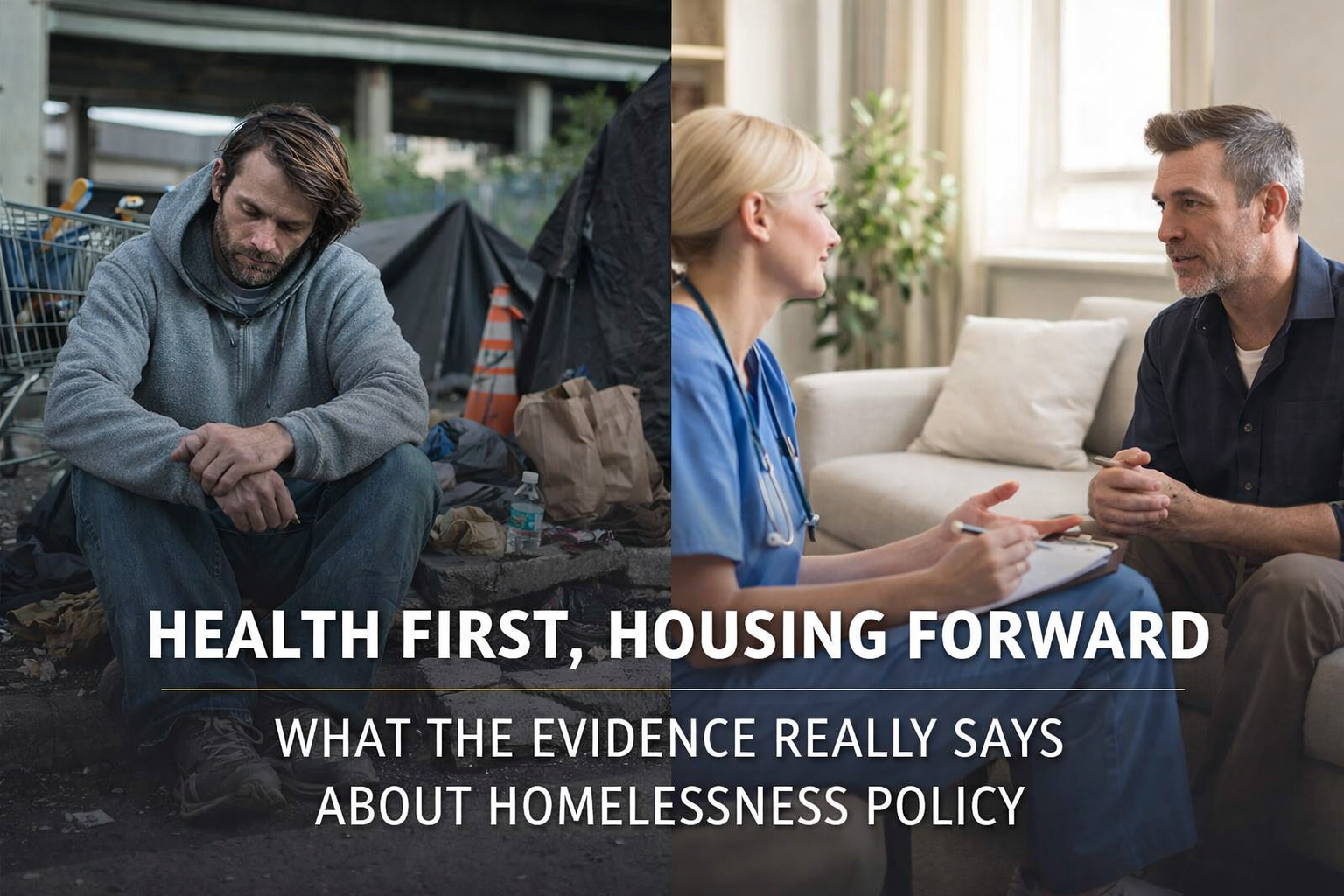
“Housing does not heal people, and health alone does not house them. Stability happens when we stop treating homelessness as an ideology and start treating it as a sequence.”
I recently read the New York Times piece, “Trump Says ‘Housing First’ Failed the Homeless. Here’s What the Evidence Says,” by Jason DeParle. It is a rare article in today’s climate because it does something most policy debates avoid. It slows down. It looks at evidence. And it admits complexity instead of turning homelessness into a political slogan. Trump Says ‘Housing First’ Fail…
The article makes a point that is uncomfortable for both sides of the aisle: Housing First works at what it was designed to do, and it struggles where it was never designed to operate alone.
The evidence is clear and well established. Housing First programs are effective at placing people into housing, at least in the short to medium term. Multiple studies cited in the article, including reviews published in The Lancet and evaluations in Santa Clara County, show significantly higher housing stability compared to “usual care.” That is not a political claim. That is a research finding. Trump Says ‘Housing First’ Fail…
It is also factually accurate that Housing First has played a major role in reducing veteran homelessness through HUD-VASH, where housing vouchers are paired with intensive case management from the Department of Veterans Affairs. Veteran homelessness has declined by more than half over the last fifteen years. The article correctly notes that this outcome is supported by strong funding, a defined population, and a nationwide clinical infrastructure that is difficult to replicate at scale for the general population. Trump Says ‘Housing First’ Fail…
Where the article becomes more challenging, and more honest, is in acknowledging what Housing First does not consistently deliver.
The research does not show reliable improvements in mental health, substance use outcomes, or mortality. Multiple long-term studies cited in the article, including Canadian and U.S. cohorts, show no statistically significant reduction in death rates compared to other interventions. That is not an opinion. It is what the data shows, even when the result feels counterintuitive. Trump Says ‘Housing First’ Fail…
This is where the conversation usually breaks down. One side treats Housing First as a moral absolute. The other treats it as a failed experiment. Neither framing is accurate, and neither helps people living on the street today.
Housing First was designed to solve homelessness as a housing access problem. It was never designed to function as a health system, a behavioral health intervention, or a substitute for clinical stabilization. Expecting it to do so is not evidence-based. It is policy drift.
That distinction matters in the real world, especially for providers like Soul Housing Recuperative Care who work every day with people exiting hospitals, emergency rooms, and crisis settings. Many of the individuals we serve are not simply unhoused. They are medically fragile, cognitively impaired, recovering from acute illness, or living with untreated psychiatric conditions. Housing alone does not resolve those realities.
This is where Health First, Housing Forward fits, not as a rejection of Housing First, but as a correction to how narrowly it has been applied.
Health First means stabilizing people when they are sick enough that housing alone will fail them. Recuperative care, medical respite, and clinically integrated transitional models exist precisely because decades of experience have shown that people often receive housing too late, after years of deterioration. The article itself acknowledges this possibility when researchers suggest that housing may come after health has already collapsed. Trump Says ‘Housing First’ Fail…
Housing Forward means that housing remains the destination, not the starting line for everyone. It recognizes that permanent housing works best when paired with timing, services, and accountability that match the person’s actual condition, not an abstract model.
This is not a left-wing argument or a right-wing argument. It is a sequencing argument.
The article also raises a legitimate concern about scale. Some economists estimate that it can take as many as ten units of supportive housing to reduce community-level homelessness by one person, particularly in high-cost markets. At roughly $20,000 per person per year for rent and services, that math matters when resources are finite. Whether one agrees with that estimate or not, it is a valid policy question, not an ideological one. Trump Says ‘Housing First’ Fail…
At the same time, blaming Housing First for rising homelessness ignores a core fact the article clearly documents: homelessness tracks housing costs. When rents exceed roughly one-third of median income, homelessness rises. Cities like San Francisco and Seattle, with extreme housing costs, show homelessness rates several times higher than lower-cost regions. That relationship is well supported in the literature and is not speculative. Trump Says ‘Housing First’ Fail…
So where does that leave us?
It leaves us in a place that demands maturity instead of slogans.
Housing First is not a failure. It is also not sufficient on its own. Treatment-first models are not well supported by evidence either, particularly when they condition housing on compliance without addressing access and trust. The data does not support replacing one rigid ideology with another.
What the evidence supports is integration.
Health First, Housing Forward is about meeting people where they are medically and psychologically, stabilizing them when necessary, and moving them into housing when they can sustain it. It is about using Housing First where it works best, not as a universal answer to every form of homelessness.
Here is the truth that tends to get lost in the noise:
Housing does not heal people. Health does not house people. Stability requires both, in the right order, at the right time.
That is not a partisan statement. It is an operational one.
And if we want outcomes instead of arguments, we need to start designing systems that reflect that reality.