The Claw Machine of Doom: Why Recuperative Care Is the Transition Layer California Keeps Missing
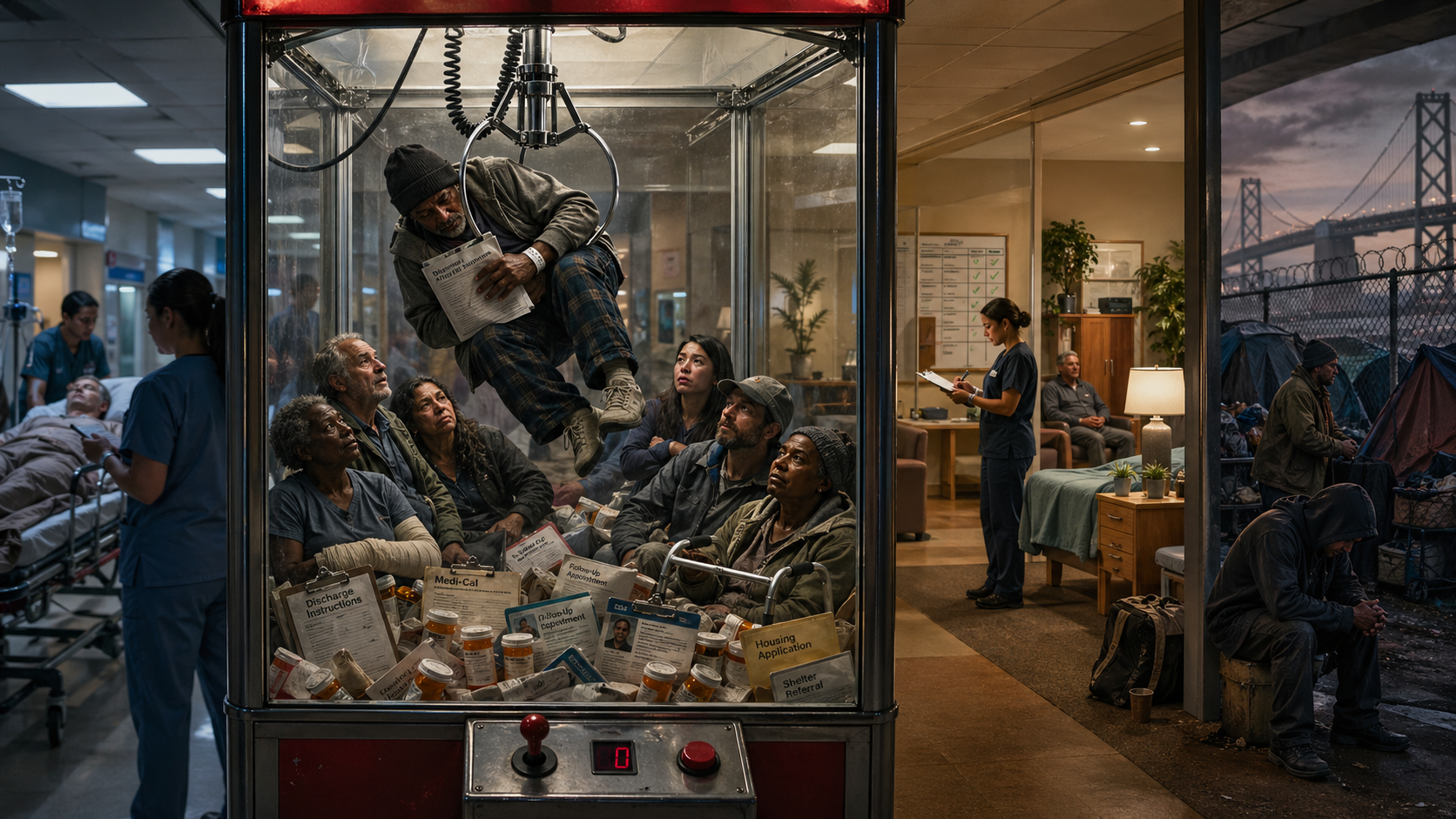
California does not have a shortage of good intentions.
It has a shortage of functional handoffs.
That is the real problem sitting underneath the fights over homelessness, Medi-Cal, hospitals, shelters, managed care plans, and county funding. Everyone has a piece of the person, but almost no one owns the transition.
That is where Recuperative Care matters.
Recuperative Care, also called medical respite, is not a skilled nursing facility. It is not a hospital. It is not permanent housing. It is also not a shelter bed with a nicer name.
It is the missing transition layer for medically vulnerable people experiencing homelessness who are too stable for a hospital or skilled nursing facility, but not stable enough to recover on the street, in a shelter, or in basic interim housing.
That distinction matters because the system keeps trying to force people into settings that do not match their actual condition.
A hospital bed is expensive. A skilled nursing facility bed is expensive. Both are licensed for a different purpose. If someone no longer needs that level of care, the hospital, independent practice association, risk-bearing organization, or managed care plan has a real incentive to find a more appropriate step-down setting.
But “more appropriate” cannot mean “drop them somewhere and hope.”
That is not discharge planning. That is a liability transfer with a discharge summary attached.
Recuperative Care is supposed to solve that gap.
At its best, RC provides a staffed, structured, non-clinical recovery environment. It gives the participant meals, laundry, transportation coordination, medication observation, documentation, daily monitoring, incident response, housing navigation, Enhanced Care Management coordination, and escalation when their condition changes.
The main function is coordination.
That sounds simple until you look at the population.
The people who need RC are often medically fragile, behaviorally complex, newly discharged, newly medicated, missing documents, disconnected from benefits, and one missed appointment away from another emergency department visit.
For that person, coordination is not a soft service.
Coordination is the intervention.
It is what makes the care plan real.
It is the difference between Home Health showing up to a known facility where the participant actually is, versus showing up to a shelter, a sidewalk, or an address that stopped being useful three placements ago.
This is also why the skilled nursing facility comparison needs to be handled carefully.
RC should not pretend to be a SNF. It should not deliver SNF-level care without a SNF license. It should not blur the line on hands-on activities of daily living.
If a participant needs toileting, bathing, transferring, or hands-on personal care, that support should come through the proper licensed provider, Home Health, Personal Care and Homemaker Services, a Home Care Organization, or another appropriate pathway.
But that does not make RC irrelevant.
It makes RC more important.
For higher-acuity participants who are close to the SNF line but still appropriate for a non-clinical setting with supports, RC can serve as the stable platform where those outside services attach. The participant is in a known location. Staff can observe, document, cue, coordinate, and escalate. Licensed services can come in and do what they are licensed to do.
That is the lane.
Not “RC does everything.”
RC creates the environment where everything else has a chance to work.
California needs to be honest about this because the current system is very good at cherry-picking.
If a person is easy to place, has documents, has benefits, can follow instructions, and makes the numbers look good, the system finds them. Everyone wants that success story.
But the most vulnerable people are not clean on paper.
They do not have stable addresses. They miss mailed notices because there is nowhere reliable to mail them. They lose coverage because the bureaucracy performed the ritual of notification, even if the person was never realistically notified. They have medical needs, behavioral health needs, mobility issues, trauma, substance use histories, and long timelines that do not fit neatly inside a 30-day authorization box.
These are the people every system quietly hopes the next system will absorb.
That is the “if I don’t see it, it ain’t a problem” problem.
And that is exactly where Recuperative Care should be strongest.
The policy risk now is that California defines RC too narrowly, funds it too weakly, or evaluates it too generically.
DHCS already treats Recuperative Care as a Community Support under CalAIM, and current guidance ties Recuperative Care, Short-Term Post-Hospitalization Housing, and Transitional Rent into a combined room-and-board framework with a six-month cap in a rolling 12-month period. That may make sense inside waiver logic, but it also shows the problem: the service is being asked to stabilize some of the hardest people in the system while the housing and room-and-board side remains politically and financially unstable.
If DHCS moves further into acuity tiers, that could be useful. A low-acuity participant is not the same as someone coming off a psychiatric hold, managing a new medication, waiting on Home Health, lacking documents, and at high risk of readmission.
But the tiers have to match reality.
A Tier 1 participant who gets seven days still may need documents, benefits, transportation, appointments, housing navigation, and a realistic discharge plan. A Tier 4 participant may need more time, more staffing, more coordination, and more clinical attachment. If the rate and authorization period do not match the work, the system will simply push the cost back onto providers, hospitals, counties, or the street.
That is not reform.
That is cost-shifting with better branding.
This is where the room-and-board problem becomes unavoidable. Federal Medicaid rules generally restrict payment for room and board, which makes any housing-adjacent Medicaid benefit structurally fragile unless the state builds a clear companion funding source.
California can keep pretending that housing, medical stabilization, and recovery can be separated cleanly on a spreadsheet. But the participant does not live on a spreadsheet.
The participant lives in the gap.
And the gap is expensive.
Hospitals pay for it through avoidable days and emergency department cycling. Counties pay for it through crisis response. Managed care plans pay for it through poor utilization and failed transitions. Providers pay for it when they are expected to deliver more than the rate supports. Participants pay for it with their health.
This is why RC is a return-on-investment tool, not just a humanitarian one.
The Whole Person Care pilots, which preceded CalAIM, showed that coordinated care for high-risk Medi-Cal populations could reduce hospitalizations and emergency department visits. That does not prove every RC provider is effective, and it should not be used as a blank check. But it does support the basic premise: when you coordinate care for high-need people instead of letting them bounce around disconnected systems, utilization can come down.
So the answer is not to leave RC vague.
The answer is to regulate it intelligently.
California should create clear guardrails for Recuperative Care:
State or county registration
Defined scope of service
Acuity tiers
Minimum staffing expectations
Clear ADL boundaries
Clinical oversight or partnership requirements
Data sharing requirements
Managed care plan accountability
Transparent outcomes reporting
Separate funding logic for room and board
This is especially urgent because the pressure is about to get worse.
H.R. 1 created major Medicaid eligibility and enrollment changes, and DHCS has said those changes could affect up to two million Medi-Cal members in California. Work requirements and related administrative burdens are expected nationally to reduce Medicaid coverage, and even where medical-frailty exemptions exist, the practical problem is verification and processing.
That is where homelessness makes the policy look absurd.
A person with no stable address may lose coverage because a notice was mailed. On paper, they were notified. In reality, the system talked to itself and called it due process.
That has been happening in lighter form for years. H.R. 1 could make it much worse.
If even a fraction of the at-risk Medi-Cal population loses coverage because the paperwork system moves faster than the outreach system, counties and hospitals will feel it first.
Los Angeles County is already under enormous pressure. The county created the Department of Homeless Services and Housing and approved an $843 million spending plan for fiscal year 2026-27, shifting responsibilities and funding away from LAHSA. That may improve accountability, but it does not magically solve the medical recovery gap.
Transitional Rent may help. Behavioral Health Services Act dollars may help. Housing First still matters. But none of them replace the need for a recovery setting between hospital discharge and long-term stability.
Without that transition layer, the system becomes a carousel.
Six months here. Six months there. Another program. Another referral. Another waitlist. Another reassessment. Another lost document. Another gap in coverage. Another crisis.
It is a vomit-inducing carousel, and only a few people get off.
The rest become statistics, or worse, they become invisible.
That is the claw machine of doom.
We keep putting dollars into the machine, hoping to grab one person out of the pile. When we do, we celebrate the win. And we should. Every person matters.
But the machine is still broken.
Most people are still just out of reach.
Recuperative Care will not fix all of homelessness. It will not replace housing. It will not replace hospitals, SNFs, Home Health, behavioral health treatment, or managed care accountability.
But it is one of the few models designed around the exact thing the system keeps failing at: transition.
If California is serious about medically vulnerable homelessness, RC should not be treated as an optional side benefit or a shelter-adjacent experiment. It should be protected, defined, measured, and expanded.
We need enough Recuperative Care capacity so medically vulnerable people are not being pushed into shelters simply because no recovery setting exists.
Not because providers want a new lane.
Because the lane already exists.
The people are already in it.
The only question is whether the state is willing to build the road, or whether we keep paying more for the crash.