What Happens When the System Runs Out of Slack
Nobody should confuse this for normal budget tightening.
When a healthcare system is already stretched thin, you can only cut so far before you stop trimming waste and start removing function. That is where California may be headed as federal Medicaid changes move from political argument to operational reality.
Medi-Cal serves more than 14 million Californians. It is the backbone of care for the lowest income populations in the state. Hospitals depend on it. Community clinics depend on it. Behavioral health programs depend on it. The safety net does not exist without it.
Current projections suggest roughly two to three million Californians could lose Medi-Cal coverage as federal policy changes take effect over the coming years. Most of those losses will not happen because people suddenly no longer qualify for care. They will happen because the system becomes harder to navigate.
More frequent eligibility checks.
Work reporting requirements.
Administrative barriers that are difficult for unstable populations to maintain.
On paper these are accountability measures. In practice they create friction.
And friction inside a fragile system has consequences.
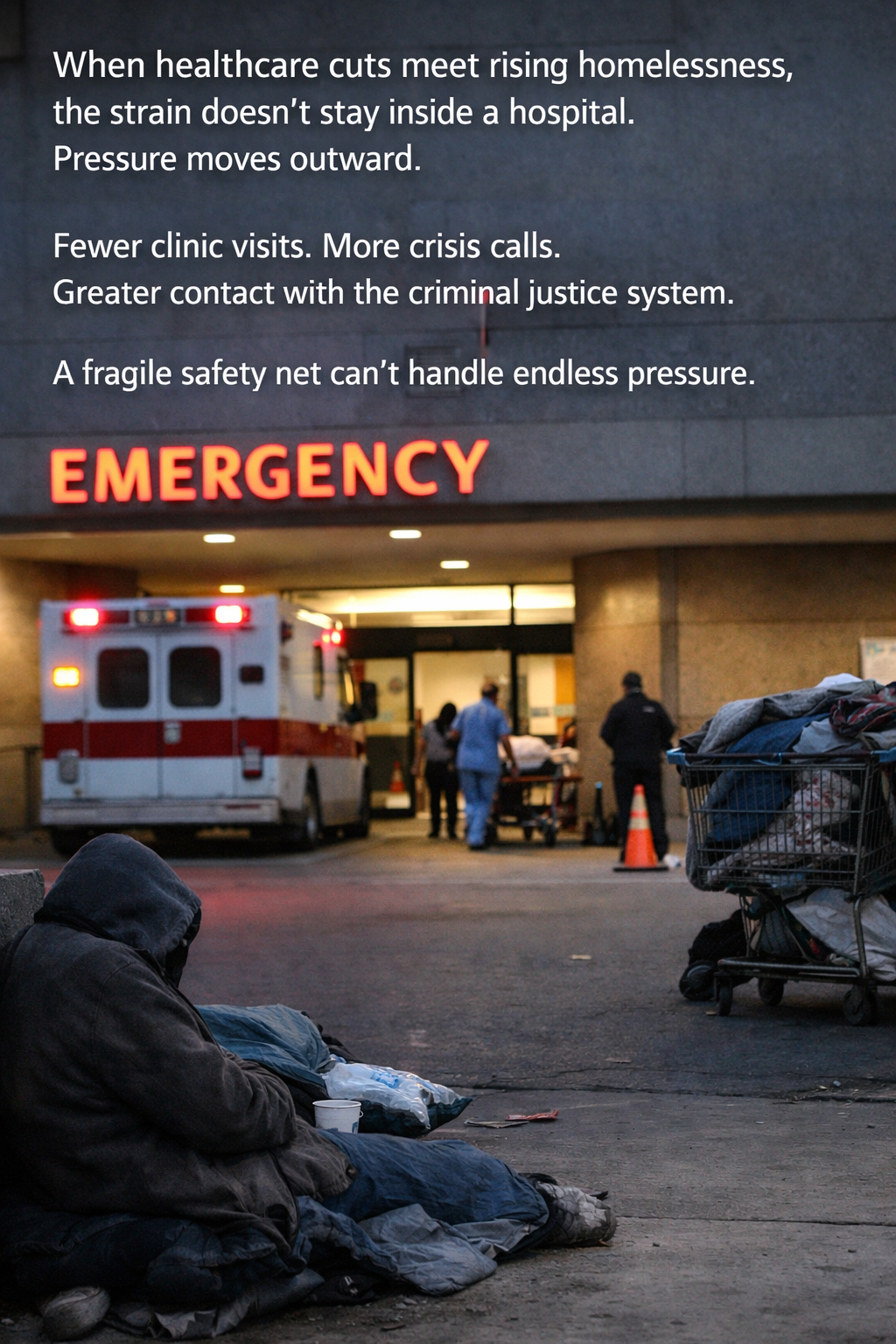
When people lose healthcare access, care does not disappear. It moves. Preventive care disappears first. Then primary care visits become sporadic. Eventually manageable conditions start showing up in emergency rooms instead.
That pressure travels outward.
Emergency departments absorb it first. Hospitals struggle with discharge planning. Clinics stretch resources across growing caseloads. Programs designed to stabilize people after hospitalization begin operating closer to their limits.
This is where the stress fractures start to matter.
People working inside safety net healthcare understand how interconnected these systems are. Hospitals depend on post discharge placements to free beds. Recuperative care programs depend on hospital referrals to keep patients from returning to the street after surgery or illness. Behavioral health systems depend on continuity of care to keep conditions stable.
Remove stability at one point and disruption travels through all of them.
The people who feel it first are usually the ones already closest to the edge. People living with chronic illness. People managing serious mental health conditions. People recovering from addiction. People living without stable housing.
For them, healthcare coverage is not an abstract benefit. It is the thin line between a manageable condition and a medical crisis.
At the same time many cities are increasingly relying on enforcement tools to manage visible homelessness. Camping bans, citations, and quality of life ordinances are becoming more common as public frustration grows.
Those two trends moving together create a dangerous feedback loop.
When healthcare access narrows, untreated illness rises. Behavioral health destabilizes. More people cycle through emergency systems. Public disorder increases. That increases contact with law enforcement.
Researchers have documented the relationship between homelessness and incarceration for years. The connection runs both directions. Homelessness increases the likelihood of citation and arrest. Incarceration disrupts housing, employment, and healthcare, which increases the likelihood of homelessness after release.
Healthcare access has been one of the few tools capable of interrupting that cycle.
Programs funded through Medicaid allow people to receive treatment instead of entering repeated crisis. Medical respite programs allow patients discharged from hospitals to recover somewhere safe instead of returning to the street. Behavioral health treatment keeps conditions manageable that would otherwise escalate.
When that infrastructure weakens, the system does not quietly adapt.
It absorbs shock.
The public will feel that shock in emergency rooms, in overcrowded jails, and in the growing visibility of untreated illness in communities already struggling to respond.
This is the part of the conversation that often gets missed.
Safety net systems operate close to capacity even in stable times. They rely on thousands of people inside them constantly compensating for gaps and shortages. The system works not because it is strong, but because people inside it keep it working.
Slack is what allows complex systems to absorb pressure without collapsing. It is the extra capacity that lets hospitals handle surges, clinics manage growing demand, and community programs stabilize people before conditions spiral into crisis.
Right now that slack is thin.
If millions of people lose healthcare coverage while communities continue struggling with housing shortages and behavioral health needs, the pressure will not stay contained inside the healthcare system.
It will spread outward.
And once a safety net breaks, rebuilding it is far harder than maintaining it in the first place.